
Window and Door Trouble Is Common in Pasco County Homes
Windows and doors do more work in Florida than most homeowners realize. They hold back heat, humidity, wind-driven rain, salt air, and outside noise, and they are also part of how your home is secured. When something starts to go wrong, the first signs are usually small: a draft you feel on a breezy evening, a sash that sticks, a lock that needs a shove, or a faint musty smell near a frame.
Daly Aluminum is based in Holiday, in Pasco County, and we work with homeowners across Pasco, Pinellas, and Hernando Counties. The questions we hear most often are about comfort, energy use, storm readiness, and how to tell a minor annoyance from a real problem. This guide walks through the issues we see most, what usually causes them, how impact-rated window and door products are designed to help, and what to check before you spend money.
Why Small Window and Door Problems Get Expensive
A failed seal or a gap around a frame is not just a comfort issue. Air leakage makes your cooling system run longer than it needs to, and moisture that gets past a frame can reach drywall, trim, and framing. By the time staining or soft trim shows up, the repair is usually larger than the original fix would have been.
Costs vary too much by home, product, and scope for anyone to quote a meaningful number in an article. What we can say is that inspecting early and addressing water intrusion promptly is the cheapest path in almost every case. If you want a number for your own home, ask for a written, project-specific estimate.
Common Window Problems We See
Drafts and air leakage
Older single-pane units, worn gaskets, and frames that were never sealed properly at installation all let conditioned air escape. You may notice a room that never quite cools, or dust collecting along a sill.
Condensation and moisture
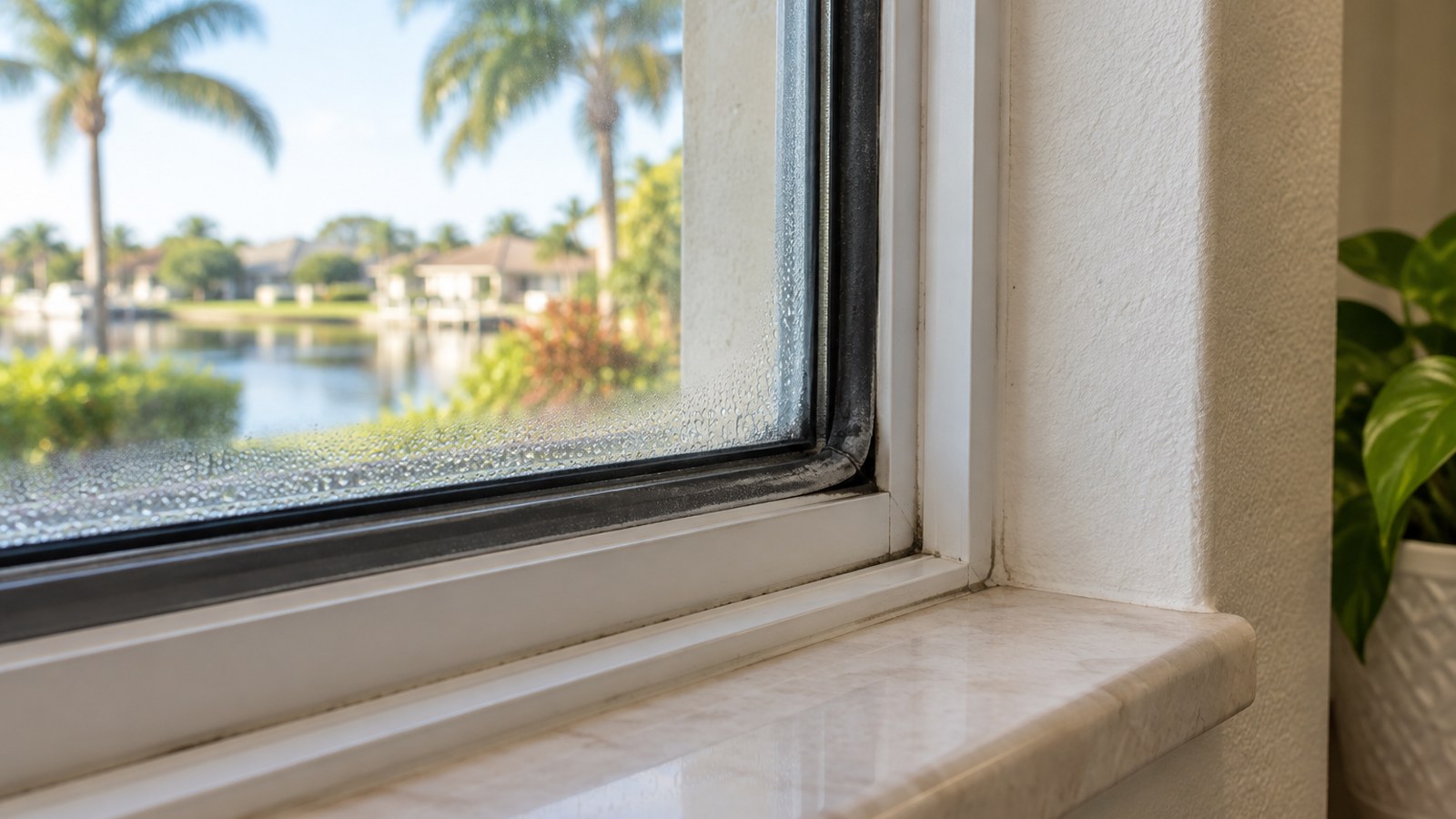
Some surface condensation is normal in a humid climate. Moisture between the panes of an insulated glass unit is different: it usually means the seal has failed and the unit itself needs replacement. Persistent dampness around a frame can also lead to mold growth, which is a health and repair concern rather than only a cosmetic one.
Hardware that no longer works
Locks, cranks, balances, rollers, and hinges are moving parts, and coastal air is hard on them. A window that will not latch is a security issue as well as an operating one, and in a storm it is one more thing that will not close when you need it to.
Cracked or broken glass
Glass gets damaged by yard debris, thrown stones from mowers and trimmers, and impacts during storms. Cracked glass should be addressed quickly because the unit is no longer performing as designed, whether that means insulation, water resistance, or impact protection.
Door Problems Homeowners Tend to Overlook
Warping and misalignment
Heat and humidity are hard on doors, especially wood slabs and frames. A door that binds, drags, or shows daylight at a corner is usually out of alignment, and that gap becomes a path for air, water, and insects.
Worn weatherstripping and thresholds
Weatherstripping is inexpensive and easy to ignore until it flattens or tears. The same is true of a threshold sweep. Both are common, low-cost items that make an immediate difference in comfort.
Locks and security hardware
Deadbolts that do not fully extend, strike plates that have loosened, and multi-point locks that no longer engage are all worth fixing right away. Security hardware only helps when it operates the way it was designed to.
Finish and material deterioration
Peeling paint, chalky finishes, corrosion on hardware, and swelling at the bottom of a slab are signs that the door is losing the protective layer that keeps water out.
How Modern Window and Door Products Are Designed to Help
Most of the products homeowners in this area consider fall into a few categories: impact-rated windows and doors, insulated glass with low-emissivity coatings, and frames made from vinyl, aluminum, or fiberglass. Manufacturers such as PGT publish specifications and approval documentation for their product lines, and you can review the current details directly at pgtwindows.com.
Rather than take any marketing claim at face value, we suggest checking the two things that are verifiable in writing:
- Florida Product Approval or a Miami-Dade Notice of Acceptance. Products used in Florida generally need approval documentation showing what they were tested for. You can search approvals yourself through the state at floridabuilding.org.
- Performance ratings on the label. U-factor and Solar Heat Gain Coefficient describe energy performance, and design pressure describes structural capacity. ENERGY STAR explains what those ratings mean for the Southern climate zone at energystar.gov.
Those documents tell you what a product actually did in testing, which is more useful than any general durability claim.
What to compare when you shop
| What to check | Why it matters in Pasco County | Where to confirm it |
|---|---|---|
| Impact rating | Windborne debris requirements apply in much of the region | Product approval documentation |
| Design pressure | Describes the wind pressure the unit was tested to handle | Product approval or manufacturer spec sheet |
| U-factor and SHGC | Drives heat gain and cooling load in a hot, sunny climate | NFRC label on the unit |
| Frame material | Affects maintenance near salt air and in full sun | Manufacturer literature |
| Warranty terms | Coverage, transferability, and labor differ by product | Written warranty from the manufacturer |
Catching Problems Early
A twice-yearly walk-around takes about twenty minutes and catches most issues while they are still small.
- Look at every window and door from outside for cracked caulk, gaps, staining, and peeling finish.
- Operate everything. Open, close, lock, and unlock each unit. Sticking and grinding are early warnings.
- Feel along frames and thresholds on a windy day for air movement.
- Check for condensation between panes, which points to a failed seal.
- Look at interior trim and baseboards below windows for swelling, staining, or soft spots.
- Test weatherstripping by closing a door on a sheet of paper. If it slides out with no resistance, the seal is worn.
Repair or Replace?
Not everything needs replacement. Weatherstripping, hardware, screens, and caulking are usually straightforward. Replacement tends to make more sense when the frame is compromised, when insulated glass seals have failed across multiple units, when the units are not impact-rated and storm protection is a priority, or when age and material condition mean repairs would keep repeating.
Permits, Code, and Insurance: Set Expectations Early
Window and door replacement in Florida generally requires a permit, and requirements vary by jurisdiction and by the specifics of the work. Confirm what applies to your address with your local building department: Pasco County, Pinellas County, or Hernando County. If you live in a city or an HOA community, there may be additional review.
On insurance, wind mitigation features can affect premiums for some policies, but eligibility, documentation, and any credit are determined by your insurer and your policy, not by a contractor. Ask your agent what your carrier requires before you assume a discount. Warranty coverage likewise depends on the written terms in effect for the specific product at the time of purchase.
Talk It Through With Daly Aluminum
If you are seeing drafts, condensation between panes, hardware that no longer latches, or a door that will not seal, the useful next step is a look at the actual condition of your units and a written scope for your home. Daly Aluminum installs replacement windows and entry and patio doors across Pinellas, Pasco, and Hernando Counties.
request a consultation and we will walk your home, explain what we find in plain language, and put the options in writing.
Planning a residential improvement?
Share your project goals with Daly Aluminum and request an estimate conversation for your Florida home.
REQUEST AN ESTIMATE