
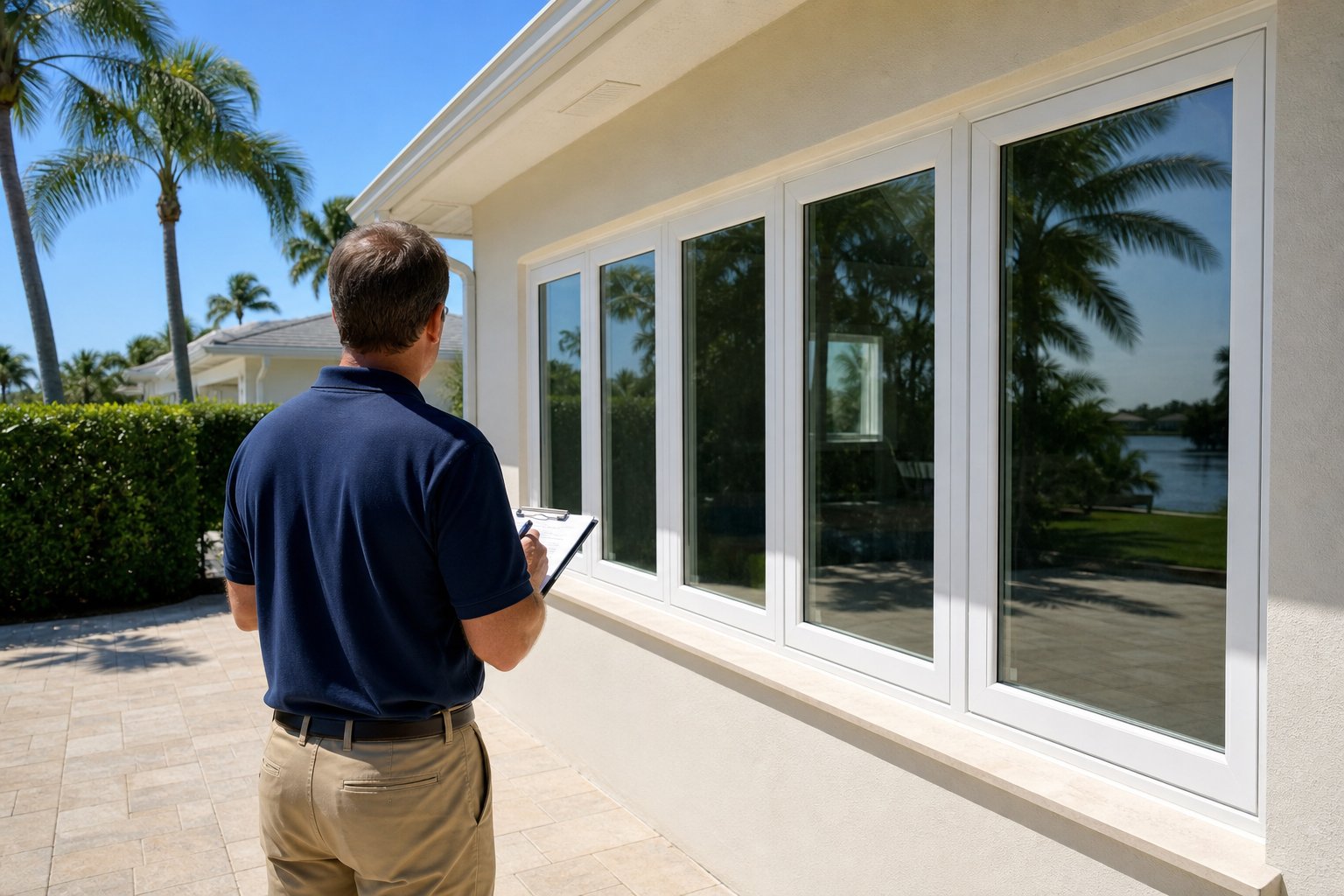
Every fall, as Florida's hurricane season winds down, homeowners across Pinellas, Pasco and Hernando counties start comparing insurance renewal notices against last year's bill. If you have replaced windows or doors with impact-rated products in the past year, there is a step worth taking before that renewal lands: a wind mitigation inspection.
Florida law requires insurers to offer premium credits for specific storm-resistant features on a home, and impact windows and doors are one of the categories that qualifies. Here is what actually determines whether your new windows translate into a lower bill, and why the paperwork matters as much as the product.
Why Florida insurance works this way
Florida Statute 627.0629 requires property insurers to give discounts, credits or other rate differentials for windstorm-resistant features, and it requires insurers to clearly disclose those discounts to policyholders. The idea is straightforward: a home built or retrofitted to resist wind damage is statistically less likely to generate a large claim, so insurers price that risk differently.
The mechanism that puts this into practice is the wind mitigation inspection, documented on the state's uniform form (OIR-B1-1802). A licensed inspector examines specific features of the home, including roof covering and shape, roof-to-wall connections, and opening protection (which includes windows, doors, garage doors and any shutters), and records exactly what is installed. Your insurer uses that form, not a general description, to calculate the credit.
Where impact windows and doors fit on the form
Opening protection is scored on the wind mitigation form based on what protects every opening on the home, not just some of them. Impact-rated windows and doors that carry a current Florida product approval or Miami-Dade Notice of Acceptance for the specific opening size and location generally qualify as protected openings. Older, non-rated storm shutters can also qualify, but the scoring is different, and a mix of impact glass on some openings and unprotected glass on others is scored as the weaker of the two, since the form does not give partial credit for finishing half the house.
That is the detail that catches people off guard. Homeowners who replace their most visible windows first and plan to finish the rest "next year" sometimes find the inspection does not reflect the upgrade they already paid for, because a home is only as protected as its least protected opening.
Keep the paperwork the inspection needs
An inspector filling out the wind mitigation form needs to see documentation, not just glass that looks thick. Keep these together for every opening you replace:
- The permit and final inspection record from the county or city building department.
- The product approval number (FL number) or Notice of Acceptance for the specific window or door installed, matched to its size and location on the home.
- The manufacturer's label still attached to the unit, which usually carries this information, plus the installer's invoice describing what was installed where.

Without that documentation, an inspector may not be able to credit an opening even when the product itself qualifies, since the inspection has to be able to prove what is installed, not assume it.
Timing the inspection
Wind mitigation inspections are typically valid for a set number of years, and insurers usually want a current one on file before applying or adjusting a credit. If you finished a window or door project this year, the practical sequence is: get the final building inspection closed out first, then schedule the wind mitigation inspection, then send the completed form to your insurance agent ahead of your renewal date rather than waiting for the renewal notice to arrive. Credits are not always applied automatically mid-term; your agent may need the form on file to recalculate the premium.
This is a conversation with your agent, not your installer
An installer can tell you what was installed and hand you the product approval paperwork. What that translates to on your specific policy (the size of any credit, how it interacts with your current coverage, and when it takes effect) is entirely between you, your insurance agent and the wind mitigation inspection. Every carrier weighs the form differently, so the same inspection can produce different results with different insurers, which is also why it is worth having the form on hand if you ever shop your policy.
Replacing windows and doors with the paperwork in mind
If you are planning a window or door project specifically with insurance in mind, treat the documentation as part of the job, not an afterthought. Ask for the product approval information in writing before installation, confirm the permit is pulled and closed, and hold onto every document until the wind mitigation inspection is done. It is far easier to gather this while a project is fresh than to track it down a year later when a renewal notice prompts the question.
If the credit does not show up on renewal
Sometimes a completed wind mitigation inspection does not immediately translate into a lower premium, and that is worth following up on rather than assuming the upgrade did not count. Ask your agent to confirm the form was received and applied, and double-check that every opening on the home was scored, not just the ones you remembered to mention. A partial inspection, a missing product approval number, or a form that was never forwarded to the carrier are the most common reasons a legitimate upgrade does not show up as a credit.
Whether you are finishing the last few openings on a partially protected home or starting from scratch, request a quote here and we can talk through which openings on your home still need attention.
Planning a residential improvement?
Share your project goals with Daly Aluminum and request an estimate conversation for your Florida home.
REQUEST AN ESTIMATE