
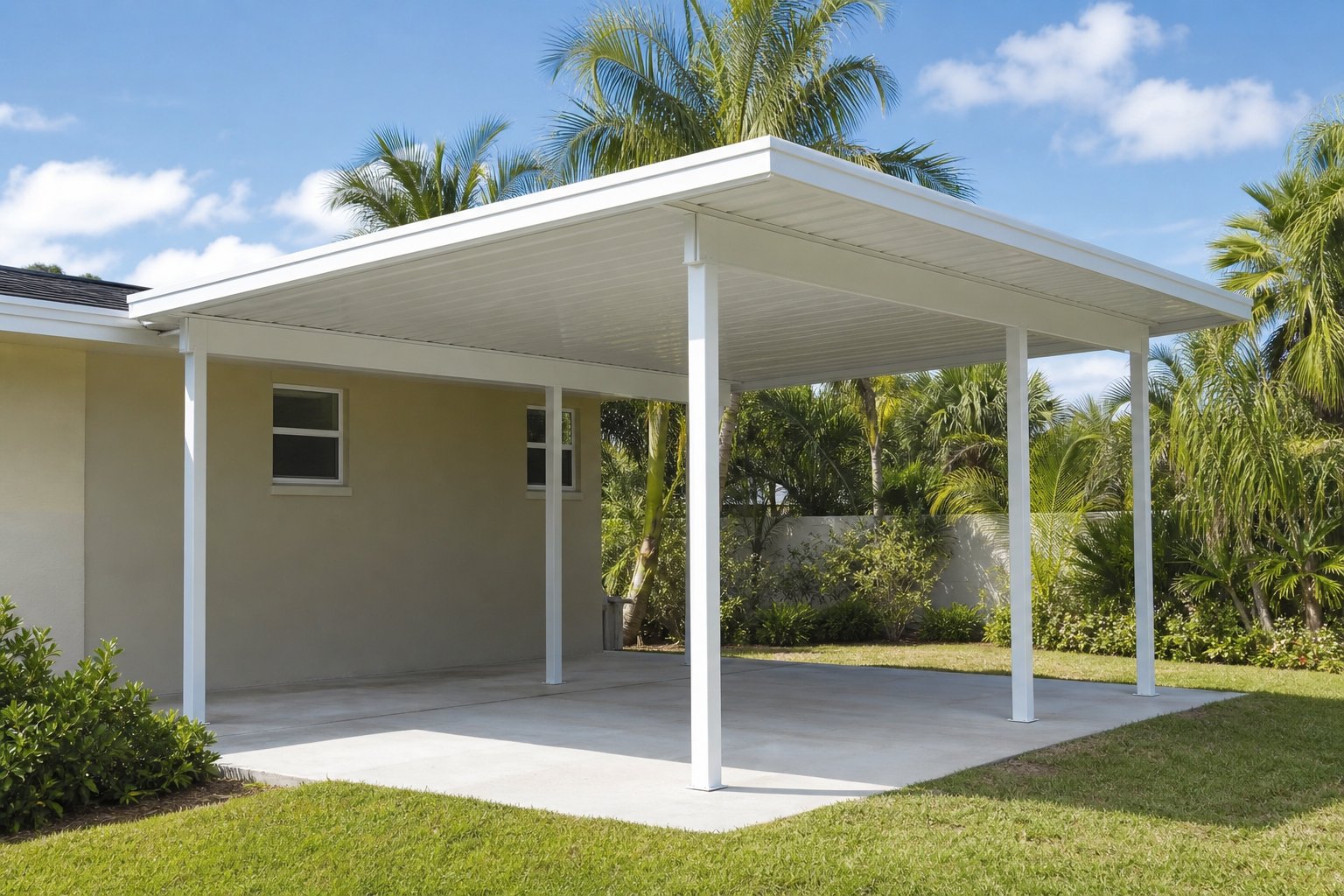
Aluminum carports, awnings and patio covers are among the most common structures added to Florida homes, and among the most commonly misunderstood. They look simple (posts, a roof panel, a connection to the wall), so it is easy to assume any competent installer with a saw can put one up. In a wind-driven coastal climate, that assumption is how carports end up in a neighbor's pool.
If you are considering a cover in Pasco, Pinellas or Hernando County, here is what actually determines whether the structure lasts, and what the numbers on a quote mean.
Why these structures are engineered at all
A roof panel is a sail. Wind moving over a flat or low-slope cover generates uplift: the force does not push the roof down, it pulls it up. That is why failures rarely start in the middle of a panel. They start at connections: where the cover meets the house, where the posts meet the slab, where the panels meet the frame.
Florida's building code addresses this directly. Structures are designed against an ultimate design wind speed for their location, and openings and attached structures in wind-borne debris regions carry additional requirements. Coastal Gulf counties sit in the higher wind speed zones, which is precisely why a carport designed for a mild-weather state is not adequate here.
What a wind rating means and what it does not
Homeowners often ask which product is "rated" for a given wind speed. It is a reasonable question with a nuanced answer.
Every window, door, shutter and structural component used in Florida construction has to be approved before it is installed. That happens either through the statewide product approval system established under Florida law, which assigns an FL number to a specific product configuration, or through a Miami-Dade Notice of Acceptance. Approval always attaches to a configuration, not to a brand: a particular panel, in a particular span, with a particular anchoring method.
Two practical consequences follow. First, a rating quoted without a configuration is close to meaningless, because the same panel at a longer span or with fewer anchors performs differently. Second, the installation has to match the approval. A correctly rated product installed with the wrong fasteners, at the wrong spacing, or into a substrate it was never tested against is not a rated installation. The paperwork says one thing; the structure behaves another way.
The connection to the house is the whole ballgame
Where an attached cover meets the wall is the most loaded and most neglected part of the assembly. Three things matter there:
- What it is anchored into. Block, tie beam, wood framing and stucco over foam all behave differently. Anchors that grip a tie beam are in a different universe from anchors that found only stucco.
- Fastener type and spacing. This comes from the approved configuration, not from what is in the truck.
- How water is handled at the joint. A connection that traps water rusts from the inside. Corroded fasteners hold a lot less than new ones, and the failure is invisible until the day it matters.
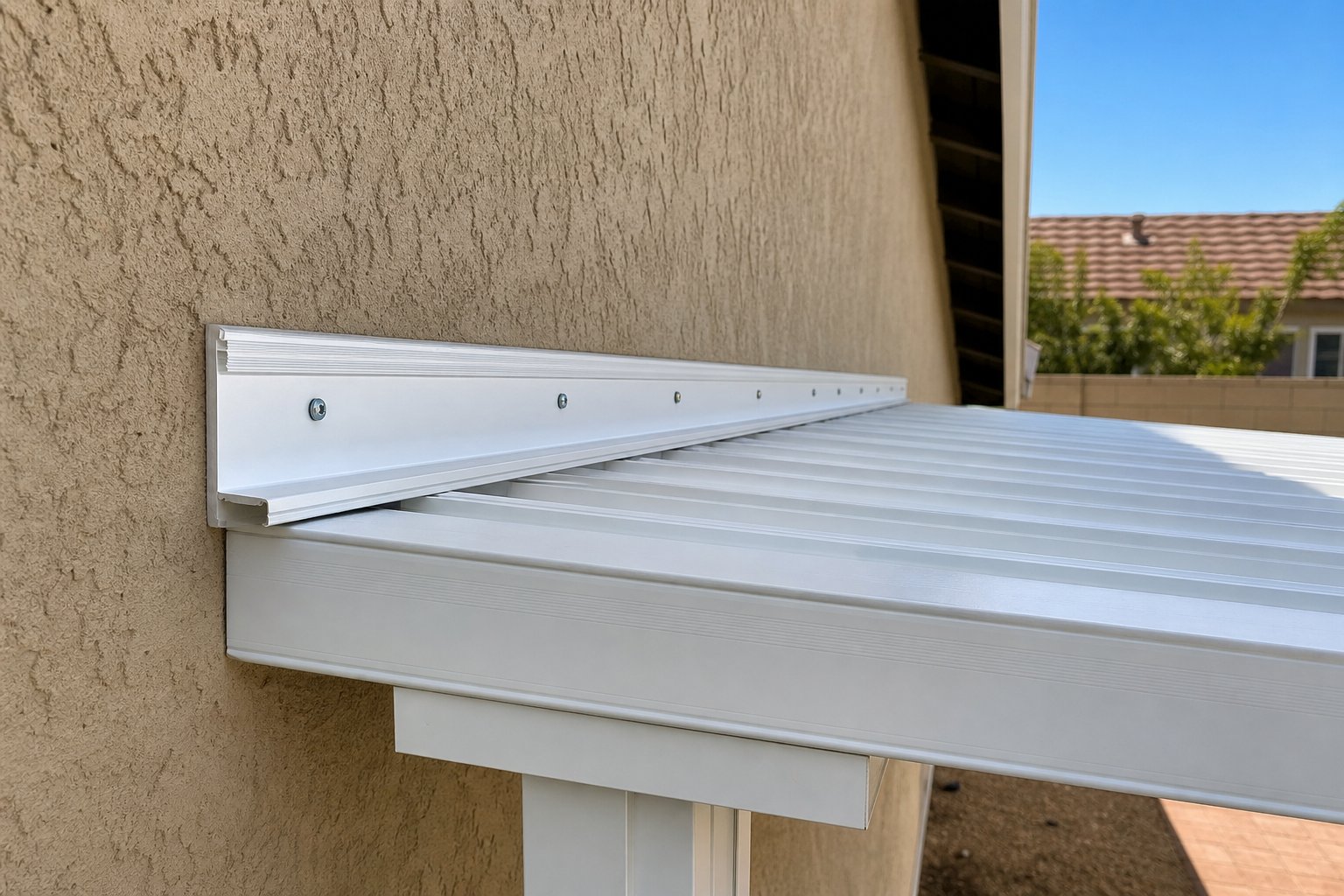
The post-to-slab connection deserves the same scrutiny. Posts have to be anchored into concrete with adequate thickness and embedment; a footing sized for the uplift is not optional. A carport anchored into a thin patio slab poured decades ago for foot traffic is relying on a foundation that was never designed to resist being pulled upward.
Yes, it needs a permit
Carports, awnings and patio covers attached to a home are permitted structures. That means plans, an approved product, an inspection, and a record that the structure exists and was built to code.
Homeowners occasionally look for a way around this, and it is a bad trade. An unpermitted structure can complicate an insurance claim after a storm, it surfaces during a title or appraisal review at resale, and if it fails and damages a neighboring property, the absence of a permit is not a helpful fact. The permit is inexpensive insurance on a structure whose entire job is to survive weather.
Aluminum, and why it is used here
Aluminum dominates Florida covers for a reason: it does not rot, it does not rust, and it carries load at a fraction of the weight of steel, which matters when the whole assembly is anchored to an existing house. It is not maintenance-free, though. Dissimilar metals in contact with aluminum in a salt-air environment cause galvanic corrosion, which is why fastener selection matters and why the cheapest hardware is a false economy within a mile of the water.
Practical maintenance is simple: rinse the structure a few times a year, especially near the coast; keep the drainage path clear so water leaves rather than pools; and once a year check that fasteners at the wall connection and the post bases are tight and free of rust streaks. Ten minutes of that beats a rebuild.
Reading a quote properly
When comparing proposals for a cover, look past the total and check that each one names the specific product and configuration being installed, states how it will be anchored at both the wall and the slab, includes the permit and inspection, and specifies the panel type and span. A quote that says only "aluminum carport, installed" is not a quote you can compare to anything, because it does not tell you what is actually being built.
If one price is dramatically lower than the others, the difference is almost always in those omitted details: lighter panels, longer spans between supports, fewer anchors, no permit.
Build it for the weather you actually get
A cover built correctly in this climate will shade a patio, protect a vehicle and survive decades of Gulf storms with very little attention. One built to the wrong standard is a liability attached to your house. The difference costs less than most people assume, and it is entirely determined by decisions made before anyone picks up a drill.
If you would like a quote that spells out the product, the anchoring and the permit, request one here.
Planning a residential improvement?
Share your project goals with Daly Aluminum and request an estimate conversation for your Florida home.
REQUEST AN ESTIMATE